
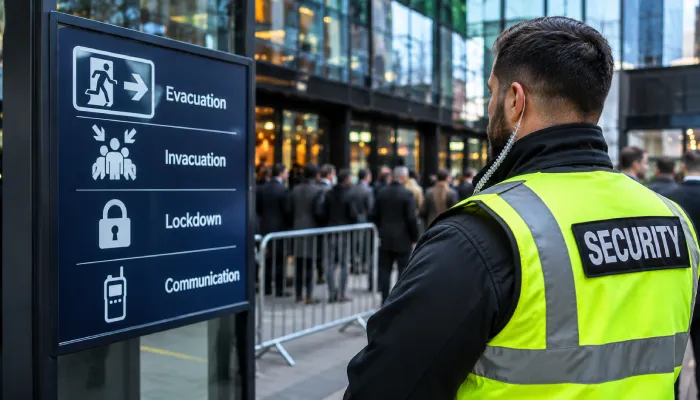
If 200 or more people can be on your premises at the same time, Martyn’s Law requirements will apply to you from Spring 2027, and the clock is already running. The Terrorism (Protection of Premises) Act 2025 became law on 3 April 2025, the Home Office published its statutory guidance on 15 April 2026, and the Security Industry Authority has been named as the regulator with power to inspect, fine and, in serious cases, prosecute. Standard tier venues of 200 to 799 people need four procedures and a notification. Enhanced tier venues of 800 or more need procedures, measures, a written assessment and a named senior individual.
That is the law in four sentences. What follows is the version of the Martyn’s Law requirements you can act on: how to tell whether you are in scope, what each tier actually has to do, who carries the legal responsibility, what the SIA can do if you ignore it, and an eight-point checklist that gets a venue ready in the five months left. We have written it for the people who will do the work: venue managers, duty managers, security contractors and the officers on the door.
Expected commencement
Standard tier capacity
Enhanced tier capacity
Martyn's Law requirements in one minute
Strip away the legal language and the Act asks three questions of every qualifying venue. Do you know what your staff would do in the first minutes of an attack? Have you told the SIA you exist? And, if you are a large venue, have you written down how you reduce your vulnerability and who signs it off?
The people who wrote the law were deliberate about proportionality. A church hall with 250 people on a Sunday is not expected to behave like a stadium. The Home Office guidance says in terms that nobody needs to pay a consultant to comply. What it does expect is that someone has thought it through, written it down where the tier requires, and made sure the staff on shift know the plan without looking it up.
The standard tier is about what your people do. The enhanced tier is about what your people do and what your building does.
Where the Terrorism (Protection of Premises) Act 2025 came from
On 22 May 2017 a bomb was detonated in the foyer of Manchester Arena as an Ariana Grande concert ended. Twenty-two people were killed, among them Martyn Hett, 29. The public inquiry found that security at the venue had been inconsistent, that staff had noticed the attacker and not escalated, and that there was no legal duty on the arena to have thought about terrorism at all. Martyn’s mother, Figen Murray, campaigned for six years for a law that would change that.
The Terrorism (Protection of Premises) Act 2025 is the result. It received Royal Assent on 3 April 2025 and the Government committed to an implementation period of at least 24 months, which puts commencement in Spring 2027. The Home Office factsheet, updated in March 2026, is the clearest official summary; the statutory guidance published on GOV.UK on 15 April 2026 is the document the SIA will hold you to.
Are you in scope? Counting to 200
The first of the Martyn’s Law requirements is to know your number. The test is capacity, not footfall. Ask: what is the maximum number of people, including staff, who could reasonably be expected to be present at the same time? Not your average Tuesday. Your busiest realistic moment.
Premises that qualify
A building, or part of one, counts if it is used for one of the purposes in Schedule 1 of the Act and 200 or more people could be there at once. The Schedule 1 list is long and ordinary: shops and shopping centres, pubs, bars, restaurants and nightclubs, hotels, theatres, cinemas, sports grounds, music venues, places of worship, hospitals, schools and universities, libraries, museums, visitor attractions, transport hubs, and offices open to the public. If your building has two uses, you go by the principal one.
Some premises are carved out even above 200. Places where the security risk is already managed by other legislation, such as airports and most rail stations, sit outside the Act, and there are specific rules for places of worship and schools that keep them at the standard tier regardless of size.
Events that qualify
An event is in scope at 800 or more if the public can attend and there is some form of entry control: a ticket, a pass, a membership or a guest list. A free festival in a park with no barriers is not a qualifying event. The same festival with a fenced perimeter and wristbands is.
Standard tier vs enhanced tier: the Martyn's Law requirements for each
Events that qualify
200 to 799 people, including staff
- Notify the SIA of the premises and the responsible person
- Evacuation procedure
- Invacuation procedure
- Lockdown procedure
- Communication procedure
- Staff able to carry them out
Maximum penalty: £10,000
Enhanced tier
200 to 799 people, including staff
- Everything in the standard tier
- Public protection measures (monitoring, access control, physical security, information handling)
- Written document with a vulnerability assessment
- Document provided to the SIA
- Designated senior individual accountable for compliance
Maximum penalty: £18m or 5% of worldwide revenue, plus daily penalties
Standard tier: four procedures and a notification
If your capacity is 200 to 799 you are standard tier, and the Martyn’s Law requirements come down to two things.
First, notify the SIA that you are a qualifying premises and who the responsible person is. That is a registration, not an application; there is no approval to wait for.
Second, have public protection procedures in place, so far as reasonably practicable, that your staff would follow if an attack happened at or near the premises. The guidance names four:
- Evacuation: how you get people out, and which exits you would and would not use depending on where the threat is
- Invacuation: how you bring people in from outside and move them away from windows and entrances when the threat is in the street
- Lockdown: how you secure the building so the attacker cannot get in or move through it
- Communication: how you tell people on the premises what to do, and how staff talk to each other and to the emergency services
There is no requirement at the standard tier to buy equipment, install anything or write a formal document, though we would strongly advise writing the procedures down. The duty is that the procedures exist and staff can carry them out.
Enhanced tier: procedures plus measures, documented
At 800 or more, everything above still applies and three things are added.
You must have public protection measures as well as procedures. Procedures are what people do; measures are what reduces the chance of an attack succeeding in the first place: monitoring the premises and the immediate area, controlling who gets in, physical security, and how information about threats is handled.
You must document your procedures and measures, include an assessment of how they reduce vulnerability and the risk of physical harm, and provide that document to the SIA.
And where the responsible person is a company rather than an individual, you must designate a senior individual who is personally accountable for compliance. That is the point at which Martyn’s Law requirements land on a named director’s desk.
Eight modules covering both tiers, the four procedures, the responsible person and SIA notification. Around five hours online, CPD certificate on completion, group pricing for venues and contractors.
Who is the responsible person?
For premises, it is whoever has control of the premises in connection with their Schedule 1 use. For a pub, that is normally the operator, not the freeholder. For a shopping centre, it is the centre management company, and each large store inside may be a responsible person in its own right. For an event, it is whoever controls the premises for the purposes of the event, which is usually the organiser.
For security contractors: the responsible person cannot delegate the legal responsibility to you. They can delegate the tasks. Expect clients to ask for your officers’ training records, because that evidence is their defence.
Your client can hire you to write the procedures, run the drills and staff the doors, but if the SIA comes knocking, the notice is addressed to them. Contractors who arrive with trained officers and certificates on file will win the work from those who do not.
What the SIA can do to you: inspection powers and penalties
The SIA’s new regulatory function, which polices the Martyn’s Law requirements, is built to support first and enforce second, and the guidance says so. But the enforcement tools are real. The SIA can require information, enter and inspect premises, issue compliance notices that say what must be fixed and by when, and issue restriction notices that limit how an enhanced tier venue can be used until it complies.
The money is tiered to match. For standard tier premises the maximum penalty is £10,000. For enhanced tier premises and qualifying events it is the greater of £18 million or 5% of worldwide revenue, with daily penalties for every day a breach continues after a deadline passes. Serious or persistent failure, and failing to comply with a notice, can be referred for criminal prosecution.
Nobody expects the SIA to open with an £18 million fine in April 2027. What venues should expect is a request to see the notification, the procedures and, for enhanced tier, the document. Not having them is the easiest finding an inspector can make.
Martyn's Law requirements for security staff: what changes on the ground
For the officer on the door, the law does not create new personal duties. It creates an expectation that the officer knows the venue’s procedures cold, because the responsible person’s compliance depends on it. In practice that means four things will show up in assignment instructions over the next year:
- Knowing the four procedures for that site, including which exits are used for which scenario and where the invacuation points are.
- Recognising hostile reconnaissance: people photographing exits and CCTV, testing responses, asking unusual questions about staffing and timings.
- Reporting and escalation: who to tell, how fast, and what to say. The Manchester inquiry turned on an escalation that did not happen.
- Running and taking part in drills, because a procedure nobody has walked through is not reasonably practicable; it is a piece of paper.
This is also why the SIA has put Martyn’s Law awareness into the common unit of the new licence-linked qualifications due in 2027. We covered that in our guide to the SIA training changes 2027. Officers licensed under the current specification will meet it at renewal, which leaves a gap of up to three years that employers need to fill with their own training now.
The Martyn's Law checklist: eight things to do in the next five months
1
Work out your capacity and tier. Use your fire risk assessment occupancy figure as the starting point and include staff. If you sit near 200 or near 800, get the number right; it decides everything else.
2
Name the responsible person. Write it down, and if that is a company, name the senior individual who will own compliance.
3
Write the four procedures. Evacuation, invacuation, lockdown, communication, each specific to the building. Our guide to emergency evacuation protocols for UK hotels is a worked example.
4
If enhanced tier, add measures and an assessment. Monitoring, access control, physical security, information handling, and a plain-English explanation of why each reduces vulnerability.
5
Train every member of staff who could be on shift, not just security. The bar staff and the ushers are the ones closest to the public when it happens.
6
Run one drill per procedure before April. Record who attended and what was learned.
7
Brief your security contractor and ask for their training records. If you are the contractor, send them before you are asked.
8
Be ready to notify the SIA the week the duty commences. The registration route opens with commencement; have the details in a file.
Download our free Terror Threat Awareness and Response Manual for the procedures in more detail, and use the ProtectUK resources from Counter Terrorism Policing for the official scope infographics.
Martyn's Law training: who needs it and what it should cover
The Martyn’s Law requirements do not mandate a specific course. The guidance expects that people who will carry out the procedures are trained to do so, and that the responsible person can show it. The cheapest way to meet both tests across a whole team is a short, certificated online course that every member of staff completes, with the certificates kept on file.
Our Martyn’s Law Training course is £20 per person, around five hours online, eight modules covering the Act, both tiers, the four procedures, enhanced tier measures, the responsible person, hostile reconnaissance, sector-specific application and SIA notification. It is CPD-accredited and the certificate downloads the moment the learner passes. Multi-seat pricing is available for venues and contractors training a team.
Supervisors who will own the procedures on shift should add the Security Team Leader course, and venues running large events will want the Event Security Officer course for their stewards. The free ACT Awareness e-learning from Counter Terrorism Policing remains a sensible baseline for everyone. Officers who are not yet licensed start with the SIA Door Supervisor course; browse the full online course library for group bookings.
Martyn's Law requirements: quick answers
“When does Martyn’s Law come into force?”
Spring 2027, after an implementation period of at least 24 months from Royal Assent on 3 April 2025. No exact commencement date has been published yet.
“Does Martyn’s Law apply to small businesses?”
Only if 200 or more people, including staff, could be present at once. A small shop or café is almost always out of scope. A pub with a large beer garden may not be.
“Do I need to notify the SIA now?”
No. The SIA has said you do not need to notify until the Act commences. Prepare the information now so you can register in the first week.
“Do I need a consultant?”
The Home Office says no. The guidance is written so that a responsible person can comply without paid advice. Training staff is a different matter; the duty expects it.
“Does Martyn’s Law training count for my SIA licence?”
It is CPD, not a licence-linked qualification, so it does not replace your SIA course. Martyn’s Law awareness is being added to the SIA’s new qualifications from 2027, so completing it now puts you ahead of the specification.
“What happens if a venue ignores Martyn’s Law?”
Compliance notices first, then penalties up to £10,000 at standard tier or £18 million / 5% of revenue at enhanced tier, daily penalties for continuing breaches, and criminal prosecution in serious cases.
Martyn’s Law Training, £20 per person, CPD certificate on completion. Bundle it with Suspicious Package Awareness and Crowd Safety for a complete venue-readiness package, with group pricing for teams.