The body worn camera security guard question used to be “should we?” Now it is “how do we do it without breaking the law or losing the footage when it matters?” Most London door teams, retail officers and corporate front-of-house staff now wear a camera. Far fewer have been told, clearly, when to press record, how long the footage can be kept, what to do when someone asks for a copy, and how to hand a clip to police so it survives in court. This guide answers all of it, using the Information Commissioner’s own body worn video guidance as the baseline, because that is the document a complaint will be judged against.A CSCS green card course is the quickest legitimate route onto a UK construction site, and in 2026 the route has three steps that have to happen in order: a one-day Level 1 health and safety course, the CITB Health, Safety and Environment test, and the card application itself. Done properly, the whole thing takes under three weeks and costs £238.50 all in. Done in the wrong order, or with a course that no longer counts, it costs you a second attempt and a month of site work.
It is written for two readers at once: the officer who wears the camera and the manager who writes the policy. The law is the same for both. The difference is that the officer needs to know what to do in the next ten seconds, and the manager needs to be able to prove, a year later, that the officer was trained to do it.
ICO: body worn video “requires you to undertake a DPIA”
when someone “is being aggressive towards” you
when they are “merely asking for directions”
UK GDPR and the Data Protection Act 2018 apply to every clip
Body Worn Camera Training, CPD certificate
Body worn camera security guard rules in one minute
A body worn camera records people, and a recording of a person is personal data. That one fact drives every rule that follows. It means the employer who issues the camera is a data controller under UK GDPR and the Data Protection Act 2018, the officer who wears it is processing data on the employer’s behalf, and the Information Commissioner’s Office is the regulator that decides whether it was done lawfully.
In practice the rules reduce to five habits. Record incidents, not people. Tell people they are being recorded. Keep footage securely for as short a time as the purpose needs. Be able to find a clip, blur the bystanders, and hand it over when someone has a right to it. And write all of that down before the first camera is switched on, because the ICO expects a documented assessment and a policy, not good intentions.
The camera is not there to film the public. It is there to record incidents. An officer who understands that difference is already most of the way to compliant.
Can security guards wear body cameras in the UK?
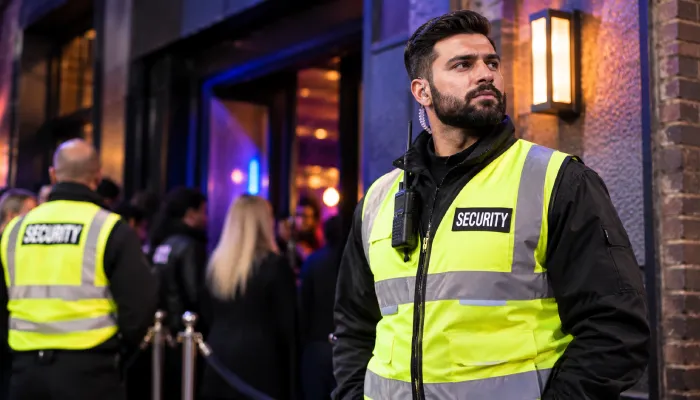
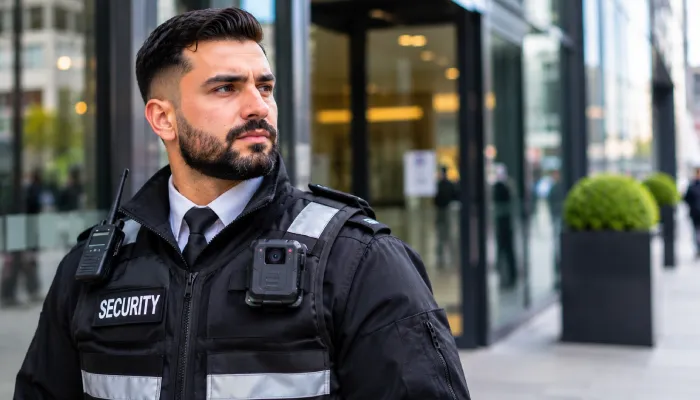
Yes. There is no law that prohibits a licensed officer from wearing one, and the ICO’s guidance explicitly uses a body worn camera security guard scenario as its worked example of lawful use. What the law does is set conditions. The use has to be justified by a real need, which for frontline security is usually officer safety, deterrence of violence and the gathering of evidence. The employer has to carry out a Data Protection Impact Assessment before deploying the cameras. People have to be told. And the footage has to be handled as the personal data it is.
One licensing point often missed: the SIA licence covers the officer’s security activity, not the footage. But anyone whose job is to review or monitor recorded footage as part of a contracted security service may fall within public space surveillance licensing, which is why control-room staff who handle body worn camera clips usually hold a CCTV licence. A door supervisor wearing a camera on shift does not need a CCTV licence to wear it.
The law: UK GDPR, the Data Protection Act 2018 and the ICO checklist
Three documents govern every body worn camera security guard deployment. UK GDPR and the Data Protection Act 2018 set the legal duties. The ICO’s body worn video guidance explains how the regulator reads those duties for cameras worn on the body. And the Surveillance Camera Code of Practice applies where the operator is a relevant authority or chooses to adopt it, which many security contractors do because clients ask. British Standard BS 8593:2017 is the industry code of practice for body worn video and is what good employer policies are built on.
The ICO publishes a checklist for body worn video. Every item on it is something an inspector, a court or a complainant’s solicitor could ask you to produce:
- A Data Protection Impact Assessment that fully addresses the use of body worn video
- Sufficient privacy information given to individuals before the cameras are used
- Staff trained to inform individuals that recording may take place if it is not obvious
- Retention and disposal policies for the footage collected
- Governance procedures that allow stored footage to be retrieved efficiently
- The ability to blur or mask footage where redaction is required
- Compliance with the Surveillance Camera Code of Practice where it applies
Notice what is on the list and what is not. There is no requirement to record everything, no rule that cameras must be on for a whole shift, and no exemption because the footage “might be useful”. The regulator’s model is selective, justified recording with a paper trail behind it.
When to switch on and when to leave it off
The ICO’s guidance is unusually direct here, and it picks a security officer as its example. It says it may be appropriate for a security guard to switch on their camera when they believe an individual is being aggressive towards them, and that it may not be appropriate to switch it on when an individual is merely asking for directions. That is the whole test: is something happening, or about to happen, that justifies recording this person?
Record
- Verbal aggression, threats or abuse towards you or anyone else
- A refusal of entry or an ejection that is being contested
- A search, with the person's consent, where an item may be found
- Suspected theft, damage or an assault in progress
- Any use of force, by you or on you
- An incident you will have to write up or that police may attend
Do not record
- Routine conversations: directions, ID checks that pass, queue management
- The whole shift by default, with no incident
- Colleagues on breaks or in staff areas
- Toilets, changing areas or medical treatment, without an overwhelming reason
- Children at a school, residents in a care home, anyone in a private dwelling, without a far higher justification
- Anything you intend to share informally or keep for yourself
Two technical points follow for the body worn camera security guard on a long shift. Continuous recording, the ICO says, requires strong justification, because it is excessive and captures bystanders going about their business. And many cameras keep a short rolling buffer so that pressing record captures the preceding seconds; that is acceptable, but the buffer should not be long. A thirty-second pre-record is defensible. A camera that is quietly saving the last ten minutes is not.
Audio, bystanders and telling people they are being recorded
Audio is the part most policies get wrong. The ICO is clear that recording sound adds to the privacy intrusion, and that the most privacy-friendly approach is a device where video and audio can be switched independently. Where they cannot, audio should only run when recording both together can be justified. For a confrontation on a door, it usually can; the words spoken are the evidence. For a search in a quiet corridor, video alone may be enough.
People have a right to know they are being recorded. The ICO gives three routes: announce it (“I am now recording”), make it obvious through signage or a visible recording light, or point people to a privacy notice. The announcement is the strongest, both for compliance and for de-escalation; many aggressive encounters end the moment the person hears those three words. Train officers to say it as the camera goes on, every time, until it is automatic. Our Conflict Management Awareness course teaches the announcement as a de-escalation step, not just a legal one.
Storing, keeping and deleting footage
Once a body worn camera security guard clip exists it has to be protected. The ICO advises encryption on the device or the storage, and prefers cameras without removable memory cards because a card is easy to lose and easy to copy. In practice that means a docking station that uploads automatically to a secure, access-controlled system, with no officer able to download a clip to a phone.
Retention should be the shortest period the purpose needs, written into policy, and applied automatically. A common and defensible structure is thirty-one days for routine footage, deleted automatically, with any clip flagged as evidence held until the matter is closed. What is not defensible is keeping everything indefinitely because storage is cheap, or deleting a clip that a complaint or a police request has already attached to.
The two breaches that end careers: an officer who copies a clip to a personal phone or shares it on a group chat, and an employer whose system lets them. Both are personal data breaches that must be reported to the ICO within 72 hours if they are likely to harm the person recorded. Both are also gross misconduct in almost every security contract.
Subject access requests and redaction
Anyone recorded on a body worn camera can ask for a copy of the footage of themselves. That is a subject access request, the employer has one month to respond, and refusing because the footage is “ours” is not an option. The ICO’s checklist requires that footage can be located and retrieved for a specific person or event, and that bystanders can be blurred or masked before the clip is released, because the requester has a right to their data and nobody else’s.
For the officer, the practical rule is to log every recording with date, time, location and a one-line description, because an un-logged clip is unfindable and an unfindable clip is a breach. For the employer, it means buying a system that supports redaction before the first request arrives, not after. Our guide to data protection for security officers covers the request process in more detail.
Two short online courses, both CPD-certified, both counted as the training the ICO checklist asks for. Group pricing with consolidated certificates for contractors and venues: 020 8050 4108.
Instant access, 12 months, certificate on completion
Handing body worn camera footage to police as evidence
Body worn camera security guard footage is only worth something if it reaches a courtroom intact. The chain that gets it there is short, and every link is a habit:
- Keep recording until it is fully over
Including the person leaving or police arriving. A clip that cuts out early invites the question of what happened next.
- Dock at end of shift, never mid-shift to a laptop
Automatic upload with a timestamp is the first link in continuity.
- Flag the clip as evidence the same day
So the retention timer stops. Overwrite cycles do not pause for police requests that arrive three weeks later.
- Write the incident report the same day
In the first person, with times that match the clip. Our Incident Report Writing course exists because a clip without a statement is a video, not a case.
- Release only through the employer, on request, logged
In a format the force accepts, with an export log recording who released what, when and to whom. Never hand a copy to an officer from your own phone.
- Keep the original
The police get a copy. The employer keeps the master until the case closes.
We set out the wider evidence routine, including CCTV and physical exhibits, in our guides to essential evidence collection for theft incidents and using CCTV legally to track shoplifting suspects, and the line between calling police and escalating internally in when to call the police at work.
Why 2026 raised the stakes: the retail-worker offence and the SIA's 2027 content
Two developments this year make body worn camera discipline more valuable than it was. The first is the Crime and Policing Act 2026, which creates a standalone offence of assaulting, threatening or abusing a retail worker and removes the £200 threshold that let low-value shop theft slide. Both provisions have Royal Assent and are awaiting a commencement date. When they start, the difference between a charge and a shrug will often be thirty seconds of clear body worn footage with audio. We covered the retail side in our guide to retail security officer training for Christmas 2026.
The second is the SIA’s consultation on the 2027 licence-linked qualifications, which proposes adding recording incidents and crime scene preservation to the common unit every officer studies. That is the regulator saying what good contractors already know: an officer who cannot handle a recording properly is not fully trained. Officers who learn it now will be ahead of the specification; see our guide to the SIA training changes 2027.
Body worn camera policy for security employers: what to write down
A body worn camera policy for security teams does not need to be long, and a body worn camera security guard should be able to read it in ten minutes, but it needs to exist before deployment and to answer the questions the ICO checklist raises. The minimum, in order:
Purpose and lawful basis. Why the cameras are used (officer safety, prevention and detection of crime, evidence) and the basis relied on, usually legitimate interests, with the DPIA attached.
Who wears them and when they are switched on. The incident-based rule above, with the examples written out for your sites.
Audio. Whether it is independent, and when it runs.
Informing people. The announcement wording, signage at entrances, and where the privacy notice lives.
Storage, access and retention. Who can view, who can export, how long routine footage is kept, how evidence is flagged and held.
Requests and disclosure. How subject access requests are handled and redacted, how police requests are logged and released.
Misuse. Personal copies, sharing, covert use and tampering as disciplinary offences, with the 72-hour breach reporting route.
Requests and disclosure. How subject access requests are handled and redacted, how police requests are logged and released.
Clients increasingly ask for this document at tender. Contractors who can hand over a policy, a DPIA and a folder of training certificates win work from those who cannot; our guides to employer obligations under the SIA and Martyn’s Law requirements explain why documented procedures are becoming the price of entry.
Body cam training course: what officers should be able to do
Training is on the ICO checklist for a reason. A body cam training course for a body worn camera security guard should leave them able to do seven things without hesitation: explain in one sentence why the camera is lawful; decide in the moment whether to record; announce the recording; keep recording until the incident has ended; dock and flag the clip correctly; describe what happens to a subject access request; and name the two things they must never do with footage. Everything else is detail.
Officers who are not yet licensed start with the SIA Door Supervisor course; the camera comes after the licence, not instead of it. Once licensed, the £25 Body Worn Camera Training covers all seven, and the £20 CCTV & Data Protection course adds the request-handling depth that control-room and supervisor roles need.
Employers: the ICO checklist item is “we train any staff using BWV”. A certificate dated before the officer’s first shift with a camera is the evidence. Enrol new starters during induction, not after the first complaint.
Body worn camera security guard checklist for your next shift
Print this, or put it in the assignment instructions. If every officer can tick all nine before the camera goes on, the deployment is compliant and the footage will be worth having.
Before the camera goes on
- I know why we use the camera, and I could explain it in one sentence
- I have completed body worn camera training and my certificate is on file
- I know the incident-based rule: aggression, refusals, searches, force, theft, anything police may attend
- I announce "I am now recording" as I switch on, every time
- I keep recording until the incident has fully ended
- I never record toilets, medical treatment, staff areas or the whole shift by default
- I dock the camera at end of shift and never copy a clip to a personal device
- I flag evidence the same day and write the report with matching times
- I know that footage is released only by the employer, on request, through the logged route
A body worn camera security guard who works this way is safer on the door, harder to make a false complaint against, and the officer whose footage prosecutors want. The camera costs the employer a few hundred pounds. The training that makes it lawful and useful costs £25 and five hours. Of the two, the training is the one that decides what the camera is worth.