SIA Door Supervisor Exam Questions: What’s in the Test, Pass Marks and How to Prepare
If you’re booked on an SIA Door Supervisor course, or thinking about it, the exam is probably the part you’re most nervous about. The good news is that there are no surprises. The SIA door supervisor exam questions all come from the course content, the format is fixed, and the pass marks are published. This guide explains exactly what you’ll face, what a typical course week looks like, ten sample questions with answers, and what happens after you pass.
How the SIA door supervisor exam questions are set
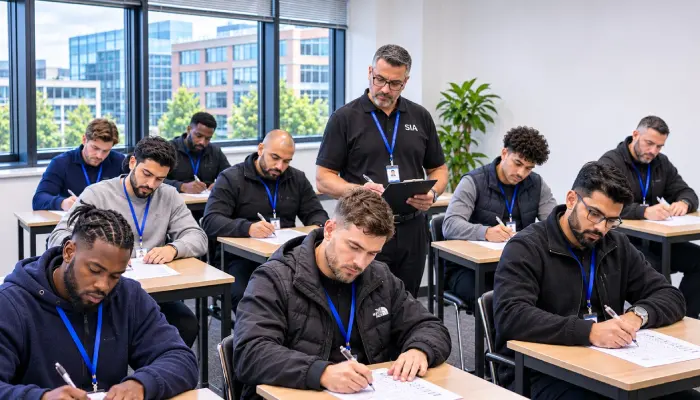
To get a door supervisor licence you need the Level 2 Award for Door Supervisors in the Private Security Industry. It has four units, and each unit has its own multiple-choice paper. Two of the units also have a practical assessment, where your trainer watches you use conflict management and physical intervention skills.
All the papers are normally sat on the last day of the course, which is Day 6 at London Security College. You must pass every unit, but if you fail one you only resit that unit, not the whole course. The number of SIA door supervisor exam questions in each paper, and the pass marks, are the same whichever awarding body your centre uses, because they are set in the official qualification specification (see the QNUK qualification specification).
Principles of Working in the Private Security Industry
The law, the SIA, health and safety, fire safety, emergencies, communication and customer care.
Principles of Working as a Door Supervisor
Licensing law, searching, arrest, drugs, crime scenes, vulnerable people, queues and admission.
Application of Conflict Management
Spotting risk, calming people down, communication skills and problem solving. Plus a role-play.
Application of Physical Intervention Skills
The law on force, risks like positional asphyxia, safe holds and escorting. Practical must be 100%.
Across the four papers that’s 172 SIA door supervisor exam questions in total. Unit 1 is the longest, but you get almost two hours for it, so time is rarely the problem. Accuracy is.
Your course week, day by day
Knowing what each day covers makes the week far less daunting. The exact order varies slightly by trainer, but a typical six-day door supervisor course looks like this:
- Day 1
The industry and the law
The SIA, the Private Security Industry Act, your responsibilities and health and safety.
- Day 2
Safety and emergencies
Fire safety, emergency procedures, communication and customer care.
- Day 4
Conflict management
Reading risk, de-escalation and the conflict role-play.
- Day 5
Physical intervention
Safe holds, break-aways and escorts, practised until they feel natural.
Emergency First Aid at Work is included with our course at no extra cost. If you’d rather get it done separately first, you can book our one-day Emergency First Aid at Work course.
The practical assessments: what to expect
The practical parts worry people more than the written SIA door supervisor exam questions, but they are very manageable if you practise during the week. For conflict management, your trainer sets up a short role-play, for example a customer who’s angry about being refused entry. They’re looking for calm body language, a safe position, active listening and a clear way to resolve the situation.
For physical intervention, you’ll show the techniques you’ve been taught: stance, keeping a safe distance, breaking away from a grab, and one- and two-person holds and escorts. The SIA exam pass mark here is 100%. That sounds scary, but it simply means you must show every required skill safely. You’re not graded on strength or speed, and if you miss a step your trainer will normally let you show it again on the day.
What you need before you can sit the exam
Every year some learners are turned away on exam day for reasons that have nothing to do with what they know. Check these three things before your course starts:
Don't get turned away
A valid first aid certificate. You must pass Emergency First Aid at Work before your door supervisor training, and the SIA’s guidance says it must be valid for at least another 12 months.
The right ID. An original passport (any nationality) or UK photo driving licence, plus two original proofs of address. Photocopies and phone photos are not accepted. Our SIA questions and answers page lists the documents accepted.
Full attendance. The SIA sets minimum training hours. Arriving late or missing part of a day can mean you can’t sit the papers, so plan travel and time off work.
10 sample SIA door supervisor exam questions
These sample SIA door supervisor exam questions follow the same style as the real papers: one question, four options, one correct answer. The right answer is ticked in green with a short explanation. Cover the answers and test yourself first.
Which law created the Security Industry Authority?
The Private Security Industry Act 2001 set up the SIA and made licensing compulsory. (Unit 1)
Which of these is one of the four licensing objectives under the Licensing Act 2003?
The other three are public safety, the prevention of public nuisance and the protection of children from harm. (Unit 2)
What must a door supervisor have before searching a customer?
Searches are a condition of entry and need consent. If someone refuses, you can refuse entry, but you cannot force a search. (Unit 2)
Which section of which Act gives a member of the public the power to arrest?
Section 24A PACE covers "any person" arrests for indictable offences. Section 3 CLA 1967 covers reasonable force. (Unit 2)
Under a Challenge 25 policy, who should be asked for ID?
Challenge 25 gives a safety margin so that under-18s are not served. (Unit 2)
What should you do first if you discover a fire?
Raising the alarm gets everyone moving. Only tackle a small fire if you're trained and it's safe. (Unit 1)
Which communication skill is most likely to calm down an angry customer?
Listening, acknowledging feelings and open body language reduce tension. Pointing and closeness increase it. (Unit 3)
Which restraint position carries the highest risk of positional asphyxia?
Prone (face-down) restraint can restrict breathing. Avoid ground holds and monitor anyone you restrain. (Unit 4)
Force used by a door supervisor must always be:
Any force must be justified in the circumstances, and every use of force should be recorded. (Unit 4)
What is the main purpose of preserving a crime scene?
Keep people out, touch nothing and note who entered, so evidence is not lost or contaminated. (Unit 2)
Got eight or more right? You’re on track. For timed door supervisor test practice, try our free Door Supervisor Mock Exam, browse every paper on our SIA mock exams page, or work through more examples on SIA mock test and answers. If conflict questions trip you up, our short online Conflict Management Awareness course is a useful refresher.
Is the SIA exam hard?
Honestly, most people who attend every day and do a little revision pass first time. The SIA door supervisor exam questions are not designed to trick you; they test whether you understand the basics of the job and the law. When learners struggle, it’s usually for one of three reasons: they haven’t learned the legal points (Acts, sections and powers), they rush and misread a question, or they haven’t practised the physical skills enough.
The SIA exam pass mark for Unit 4 is higher than the others, at 80%, so give physical intervention theory extra attention. You can only get six of the 30 questions wrong.
How to prepare: a simple five-step plan
1
Read the basics before Day 1Most SIA door supervisor exam questions come back to a handful of laws. Learn the four licensing objectives and the main Acts: PSIA 2001, Licensing Act 2003, PACE 1984, Criminal Law Act 1967 and Equality Act 2010. Our free self-study security courses are a good starting point.
2
Do one SIA mock test earlyA mock before the course shows where you’re weak. Our free online mock takes about 20 minutes.
3
Ask questions in classYour trainer knows exactly what comes up. If something isn’t clear, ask on the day rather than guess in the exam.
4
Practise the physical skills every chance you getRepeat the holds and break-aways until they feel natural. The practical is about doing every step safely, not about strength.
5
On exam day, read every question twiceRule out the obviously wrong answers first, then choose between the rest. With 110 minutes for 72 questions in Unit 1, there’s no need to rush.
After the exam: results, certificate and your licence
-
Results in 10 to 14 working days
Once you've answered the last of the SIA door supervisor exam questions, results follow by SMS and email. If you need to resit a unit, we'll arrange it.
-
Your certificate
Usually dispatched about seven days after the course. Your result is what the SIA checks, so you can often apply before the paper certificate arrives.
-
Apply for your SIA licence
Apply online and pay the £204 fee. Our SIA Get Licensed page explains the process, and our guide to the SIA licence cost covers every fee.
-
Start work
Once your licence is granted you can work on doors, at events, in retail and on static sites.
Which course is right for you?
Already licensed and renewing? You’ll sit a shorter top-up exam instead; see our Door Supervisor refresher training. Still deciding between roles? Read door supervisor or CCTV licence.
Does the 2027 SIA change affect your exam? No. The SIA consulted this autumn on new licence-linked qualifications, expected later in 2027. Until the new specification is in use, the SIA door supervisor exam questions described here are the ones you’ll sit, and your qualification stays valid. More in our guide to the SIA training changes in 2027.
Ready for the real SIA door supervisor exam questions?
The best preparation is a good course. Our six-day SIA Door Supervisor course runs every week across London, includes first aid, and finishes with the exams on Day 6, so everything is fresh when you sit the papers. Questions before you book? Contact our team or call 020 8050 4108.
Start with our free Door Supervisor mock exam. When you’re ready, book a six-day London course with first aid included and exams on the final day.