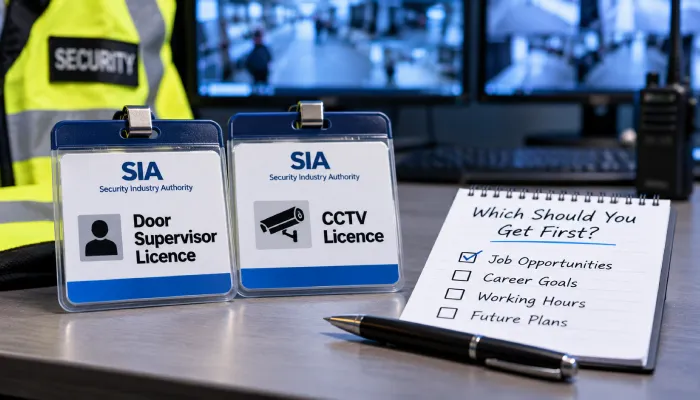
Door supervisor or CCTV licence: it is the question we hear more than any other from people about to book their first SIA course, and the honest answer is shorter than most guides make it. For most people, the door supervisor licence first, because it opens more jobs. For some people, CCTV first, because the work suits them better. And for anyone who can manage nine days of training, both together, because a rule change on 1 June 2026 made that the cheapest way to hold two licences.
This guide compares the door supervisor or CCTV licence question on the things that actually decide it: what each lets you do, where the jobs are, the hours, the pay, how hard the course is and what it costs. It ends with a plain recommendation for four kinds of reader and the maths on getting both. Prices are ours as of November 2026; the fee rules come from the SIA.
Start with the door supervisor licence unless you already know you want indoor, seated control-room work. If you can, do both on the nine-day bundle and apply for both licences on one SIA form, which halves the second fee.
Door supervisor or CCTV licence: the short answer
Think of the two licences as a key ring and a single key. The door supervisor licence is the key ring: it lets you work on the door of a licensed venue, and it also covers every job a security guard licence covers, from corporate reception to retail to construction sites. The CCTV licence is one very useful key: it opens the control room door, and only that door.
That asymmetry is why, asked door supervisor or CCTV licence, we point most first-timers at door supervision. In London there are more vacancies, more shift options and faster starts, and the licence does not stop you taking guarding work when you want a quieter night. The CCTV licence is a specialist ticket for a specialist room.
The door supervisor licence covers guarding and doors. The CCTV licence covers screens. One is broad, the other is deep.
None of that makes CCTV the wrong first choice. If you want to sit down, work indoors, avoid physical confrontation and build towards a control room or security manager role, CCTV first is a sensible move. Our guide to whether you need an SIA CCTV licence covers the legal line between monitoring your own premises and public space surveillance, which is where the licence becomes compulsory.
What each licence actually lets you do
Door Supervisor licence
Door supervision + security guarding
Licensed venues (pubs, clubs, bars)
Yes
Events and festivals
Yes
Retail, corporate, construction guarding
Yes
Public space CCTV monitoring
No
Course length
6 days
Course price
from £300
CCTV licence
Public space surveillance
Control rooms and monitoring centres
Yes
Shopping centre and corporate CCTV
Yes
Event CCTV and town-centre schemes
Yes
Door or guarding work
No
Course length
3 days
Course price
from £250
The door supervisor licence: doors, venues and guarding
The SIA door supervisor licence is the frontline licence. It is the one you need to work on the entrance of any premises that serves alcohol, and because its training includes everything in the security guard syllabus plus physical intervention and licensed-premises law, the SIA lets door supervisors do security guarding work too. One licence, two sectors. That is why we tell people the security guard course is rarely the right first choice; for a little more time and money the door supervisor licence covers it, a point we made in our door supervisor vs security guard comparison.
The CCTV licence: control rooms and public space surveillance
The CCTV licence, formally the public space surveillance licence, is required the moment you monitor cameras that cover areas the public can access, as part of a contracted security service. Shopping centres, business parks, local authority town-centre schemes, event control rooms and corporate monitoring centres all need licensed operators. The course is shorter and the work is seated, methodical and evidence-led: spotting incidents, directing officers on the ground, preserving footage, and writing it up in a way the police and courts can use. Data protection sits at the centre of it, which is why our online CCTV and Data Protection course pairs so well with it.
Jobs, hours and pay: door supervisor vs CCTV operator
Where the jobs are
Jobs settle the door supervisor or CCTV licence question for a lot of people. Search any London jobs board on a Thursday and the pattern is the same: door supervisor and security officer vacancies outnumber CCTV operator vacancies several times over. Door supervisor licences are the volume ticket. Every pub, club, hotel bar and event in the capital needs them, and the turnover is high, so new licence holders get picked up fast. Our own jobs board reflects it.
CCTV roles are fewer but stickier. Control rooms run small, stable teams on rotating shifts, and once you are in, you tend to stay. The competition for each vacancy is higher, and employers often want some frontline experience first, which is another argument for door supervision as the opening move.
Shift patterns and the indoor question
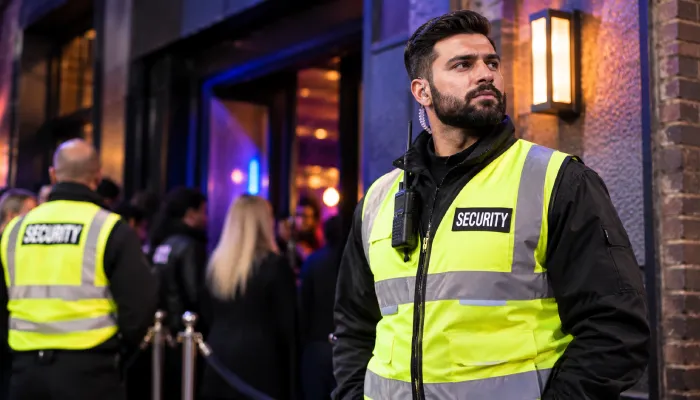
Door work is evenings and nights, Thursday to Sunday at its busiest, on your feet, outdoors in winter, dealing with people face to face. For a lot of people that is the appeal: it fits around a day job or studies, the hours are social, and the weekend premium is real. For others it is the dealbreaker.
CCTV work is indoors, seated, and runs 24/7 on a shift rota, including days. It is calmer, warmer and physically easier, and it suits people who are observant, patient and good with systems. It is also the natural route into supervisory and control-room management roles later. Our online Security Control Room Operator course is where many CCTV licence holders go next.
Door supervisor salary vs CCTV operator salary UK
In London, door supervisors typically earn £13 to £16 an hour, with higher rates for late nights, events and West End venues. CCTV operators typically earn £12 to £15 an hour, with less variation and more predictable monthly totals because the rota is fixed. Over a year the two land close together; door supervisors who take the busy shifts usually come out ahead, CCTV operators get there with fewer surprises. Run your own numbers through our salary calculator.
Course length, cost and difficulty compared
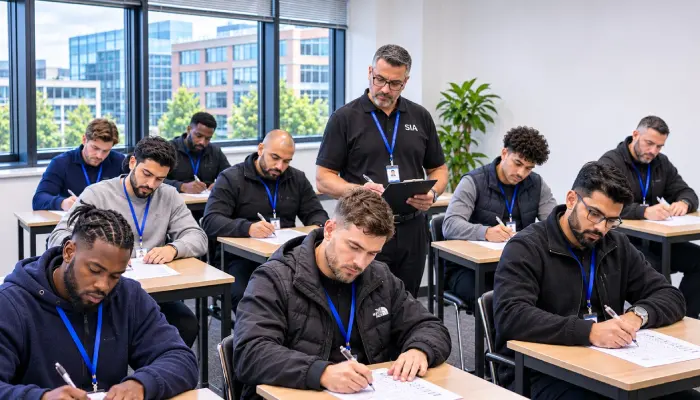
The SIA Door Supervisor course is six days, 9am to 6pm, from £300 to £370 depending on venue, with Emergency First Aid at Work and all exam fees included. You sit four multiple-choice exams and a practical physical intervention assessment on day six. It is the longer and more demanding of the two, mainly because of the physical intervention unit and the volume of law.
The SIA CCTV Operator course is three days, 9am to 6pm, from £250 to £300, exam fees included, no first aid requirement. You sit two written exams and a 25-minute practical control-room scenario. People who are comfortable with screens and procedure find it the easier course; people who prefer being on their feet find the three days of concentration harder than they expected.
Both courses lead to the same £204 SIA application fee, which we broke down in full in our guide to the SIA licence cost 2026. Free practice tests are available for both: door supervisor mock exams and CCTV mock exams.
Door Supervisor (6 days, first aid included) plus CCTV Operator (3 days) at Bethnal Green, £50 less than booking separately. £150 deposit secures your place.
Is a CCTV licence worth it on its own?
Yes, if the control room is where you want to be, and it reframes the door supervisor or CCTV licence choice as a question of workplace rather than value. CCTV operators are in steady demand from shopping centres, corporate estates, local authorities and event companies, the work is indoors and seated, and it leads naturally into supervisory roles. A CCTV licence is also the right choice if a physical intervention assessment is not something you can or want to do.
Where a CCTV licence on its own falls short is flexibility. You cannot take door or guarding shifts to fill a quiet week, and some control rooms prefer operators who have done frontline work and understand what the officers on the radio are facing. That is the strongest practical case for the door supervisor licence first and CCTV second, or both at once.
Two SIA licences: the 50% discount changed on 1 June 2026
The SIA charges £204 per licence, and it has long given 50% off a second licence in a different sector. So a door supervisor adding CCTV should pay £204 plus £102. Since 1 June 2026, though, the discount only applies when both licences are applied for on the same day, on the same application form. Apply for the second one later, even a month later, and it is £204 again.
Since 1 June 2026: two licences on one form = £306. Two licences on two forms = £408. If you think you will want both, train for both before you apply.
The SIA’s reasoning is that every separate application repeats the full criminal record and identity checks, so a separate application costs it the same as a first one. For you the implication is simple. Deciding between a door supervisor or CCTV licence is a question you only have to answer if you are sure you want just one. If there is any chance you want both, do both courses, apply once, and save £102 on the fee and £50 on the training.
Door supervisor or CCTV licence: who should pick which
Door supervisor first if you…
- Want the widest choice of jobs and the fastest start
- Prefer evening and weekend hours around a day job or study
- Are comfortable on your feet and dealing with people
- Want the option of guarding work as well as doors
CCTV first if you…
- Want indoor, seated work on a fixed rota
- Would rather not do physical intervention
- Are detail-driven, patient and good with systems
- Are aiming at control room or security management roles
Both together if you…
- Can commit nine days of training
- Want to be the candidate who can cover the door and the control room
- Want the 50% second-licence discount, which now needs one application
- Plan to move into supervision within a few years
One more group worth naming: people with a licence expiring soon. If you already hold a door supervisor licence and want to add CCTV, our Door Supervisor Refresher + CCTV bundle at £430 does the renewal and the new licence in one booking, and you can apply for both on one form at renewal.
The nine-day bundle: both licences, one booking
Our Door Supervisor + CCTV bundle runs the six-day door supervisor course Monday to Saturday and the three-day CCTV course the following Wednesday to Friday, at Bethnal Green, for £550 instead of £600. First aid and every exam fee are included, and a £150 deposit holds the place. The same bundle runs at Forest Gate (£580) and Stratford (£560).
Door supervisor course + CCTV course booked separately
£600
DS + CCTV bundle, Bethnal Green
£550
SIA fee, both licences on one form (£204 + £102)
£306
Two licences, all in
£856
Compare that with £300 to £370 plus £204 for a door supervisor licence alone, and the second licence is costing you about £280 and three extra days. For a qualification that is valid for three years and doubles the jobs you can apply for, that is the best value on our price list. If you would rather train nearer home, the door supervisor and CCTV operator courses also run at our East London and Park Royal venues through our refresher training site.
Thinking about 2027? The SIA is rewriting both qualifications for launch later in 2027, with longer content and an added English test proposed. Training now, under the current specification, is the shorter and cheaper route. Our guide to the SIA training changes 2027 has the detail.
Door Supervisor from £300, CCTV Operator from £250, or both for £550. First aid and exam fees included, sixteen London venues, payment plans available.