How to Handle Trespassers on Construction Sites After Hours
A practical, legally sound guide for site managers and security officers on what to do when someone is on your site after the gates close.
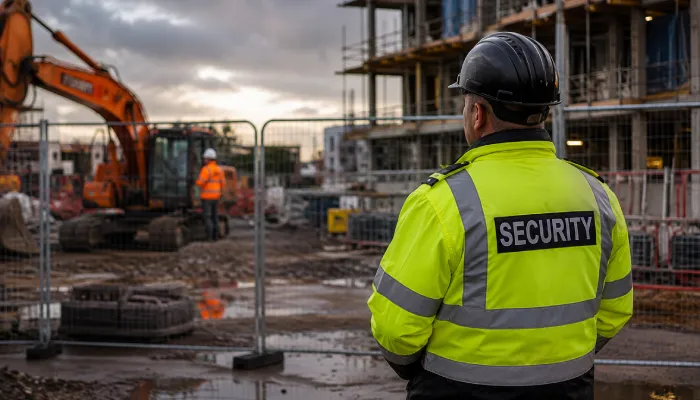
When the last van leaves and the gates are locked, a building site becomes one of the most tempting and dangerous places in any neighbourhood. Trespassers on construction sites are a growing problem across the UK, from curious teenagers and rough sleepers to thieves and urban explorers chasing crane-top videos. Every intrusion puts lives, equipment and your project timeline at risk.
The cost is real. A single night-time break-in can mean stolen plant, a damaged scaffold that has to be re-inspected, a delayed pour and a frustrated client. Worse still, an injured child or urban explorer can trigger a liability claim and a HSE investigation. This guide explains exactly how to handle trespassers on construction sites after hours, what the law allows you to do, and how trained security teams stop intruders before they become a headline.
What every site team needs to know
- Simple trespass is usually a civil matter, but criminal damage, theft and aggravated trespass are police matters.
- Site occupiers owe trespassers a duty of care under the Occupiers’ Liability Act 1984, so an injured intruder can still bring a claim.
- Security officers have the same legal powers as any member of the public, so observation, communication and good records matter more than force.
- CDM 2015 requires principal contractors to take reasonable steps to prevent unauthorised access to the site.
Why after hours is the highest-risk period
During the working day, a site is full of supervisors, operatives and banksmen who would notice a stranger in seconds. After hours, that natural surveillance disappears. Lighting is reduced, plant sits unattended and open excavations become invisible in the dark. That is why most trespassers on construction sites arrive between dusk and dawn.
Trespassers on construction sites usually fall into a few groups:
- Thieves targeting tools, cable, fuel and plant. Our guide to construction site theft prevention covers this threat in detail.
- Children and teenagers who see scaffolding and machinery as a playground.
- Urban explorers who climb tower cranes and unfinished structures for social media content.
- Rough sleepers looking for shelter in welfare cabins or partly built units.
- Vandals and fly-tippers who cause damage or dump waste.
What the law says about trespassers on construction sites
Many site teams assume that trespassers on construction sites have no rights at all. That is a costly mistake. The Occupiers’ Liability Act 1984 means occupiers can owe a duty of care to trespassers where they know about a danger, have reason to believe someone may come near it, and could reasonably be expected to offer some protection. Children are treated with extra care because the courts accept that they are naturally drawn to sites and may not recognise danger.
On top of this, Regulation 13 of the Construction (Design and Management) Regulations 2015 requires the principal contractor to take reasonable steps to prevent access by unauthorised persons. The HSE’s CDM guidance makes clear that site security is a safety duty, not just a commercial one.
| What happens on site | Legal position and who acts |
|---|---|
| Someone enters without permission but causes no damage | Civil trespass. The site team asks them to leave and records the incident. |
| A group enters to block or disrupt work, such as a protest | Aggravated trespass under s.68 CJPOA 1994. This is a police matter. |
| Tools, cable or fuel are stolen, or property is damaged | Criminal offence. Call 999 if it is happening now, or 101 afterwards. |
| An intruder is injured by a site hazard | Possible civil claim under the Occupiers’ Liability Act 1984, handled by site management and insurers. |
7 vital steps when you find trespassers on construction sites
Whether you are a static guard, a mobile patrol officer or a site manager responding to an alarm call, follow this sequence. It keeps you safe, protects the intruder from site hazards and gives the police the evidence they need
1
Observe and assess from a safe distance. Do not rush in. Trespassers on construction sites may be armed, under the influence or simply frightened. Use CCTV or a concealed vantage point to note how many people there are, what they are doing, whether they are carrying anything, and where they are in relation to hazards like open trenches or scaffolding.
2
Raise the alarm and call for support. Report to your control room or supervisor before you act. If a crime is in progress or anyone is in danger, call 999. For non-urgent matters, use 101. Our guide on when to call the police at work explains where the line sits.
3
Approach only when it is safe. If the risk is low, approach in a well-lit area, identify yourself clearly and keep a calm, open tone. Switch on your body-worn camera if you have one. Most intruders leave without argument once they know they have been seen, and strong conflict management skills prevent the rest from escalating.
4
Ask them to leave by the safest route. Explain that they are on private property and must leave. Guide them out along a route that avoids excavations, plant and edges, rather than the way they came in, which may be the most dangerous path on site.
5
Know your legal limits. Security officers have no special powers when dealing with trespassers on construction sites. You can use reasonable force only where it is genuinely necessary, and you may only carry out a citizen’s arrest for an indictable offence under s.24A PACE 1984. You cannot search or detain someone simply for trespassing.
6
Record everything. Write a clear incident report while the details are fresh: times, descriptions, actions taken and who was informed. Preserve CCTV footage straight away. Professional report writing is what turns an incident involving trespassers on construction sites into usable evidence.
7
Secure the breach and review. Find and repair the entry point before the end of your shift where possible. Update the site risk assessment and brief the day team so the gap is closed for good. Repeat visits by trespassers on construction sites are common when a weak point is left unfixed.
Think of these steps as a habit rather than a checklist. Officers who practise them on every patrol respond calmly when it matters, and calm responses are what keep incidents small.
Never chase trespassers across a live site at night. Unlit excavations, rebar and unguarded edges are as dangerous to you as to them. A pursuit that ends in injury creates liability for everyone involved.
How to stop trespassers coming back
The best way to handle trespassers on construction sites is to make sure they never get in. Effective after-hours security against trespassers on construction sites works in layers:London Construction College runs CPD-certified online construction courses built around exactly these failures. The three-hour Key Holding and Alarm Response course is the best starting point for out-of-hours security, while Site Induction and Toolbox Talks training helps supervisors embed access control from a worker’s first day.
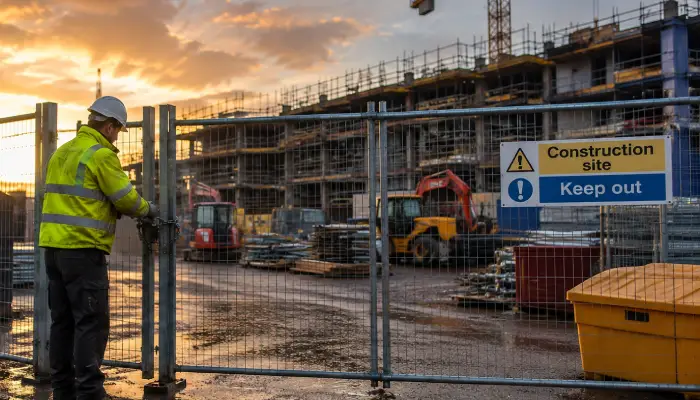
- Perimeter: secure, anti-climb hoarding or Heras fencing with regular checks for gaps and loose clips.
- Signage: clear warnings at every access point stating the site is private, monitored and dangerous.
- Lighting: motion-activated lighting around compounds, cabins and plant storage.
- CCTV and alarms: remotely monitored cameras with audio challenge, managed by SIA-licensed CCTV operators.
- Hazard control: remove ladders, lower crane hooks, isolate plant and cover excavations at the end of each day.
- Manned guarding: trained static guards or mobile patrols, especially on large or high-value sites.
For a wider view of site protection, read our guide to construction site security and the key health and safety risks for site security officers.
Why trained people make the difference
Fences, lights and cameras deter casual intruders, but determined trespassers on construction sites are stopped by people. The officer who spots movement on a monitor, keeps their voice level at 2am and writes a report the police can actually use is worth more than any piece of hardware.
Anyone providing contract guarding needs a licence from the Security Industry Authority (SIA). Many officers choose the SIA Door Supervisor course because the licence also covers guarding, which opens doors to construction, events and venue work in one go. If you only plan to work static sites, the SIA Security Guard course is the direct route, while the SIA CCTV Operator course prepares you to watch over sites remotely and spot intruders before they reach the plant.
Already licensed? Sharpen your site skills with the online Construction Site Security Officer course and the Night Shift Security Officer course, both built around the realities of after-hours work. The Incident Report Writing course makes sure every encounter is documented properly.
Site managers and supervisors carry the legal duty to keep unauthorised people out. The CITB SSSTS course builds that practical knowledge, and the CDM Regulations Pack explains every dutyholder’s responsibilities under CDM 2015. You can browse every classroom option on our construction courses in London page, or study at your own pace through our online construction courses.
Keeping Trespassers on Construction Sites Out for Good
Handling trespassers on construction sites after hours is less about confrontation and more about preparation. Secure the perimeter, control the hazards, know exactly what the law allows and train your people to observe, communicate and record. Do that consistently and most intrusions end quietly, with nobody hurt and nothing lost.
Ready to take the next step? Explore our full range of security online courses or call our team on 020 8050 4108 to find the right training for you or your site team.
Train your whole site team from £30 per person
CPD-certified and fully online, with the certificate available the same day and 12 months of access. Group and company bookings receive volume pricing.
Arranging training for a crew? Call 020 8050 4108.